




During the Eighty Years' War (1568-1648), the Spanish general Spinola raised armies to put pressure on the rebellious Dutch provinces. Prince Maurits wanted to make a military countermove by attacking cities along the Rhine. But his client on behalf of the Republic, Johan van Oldenbarnevelt, wanted to conquer Flanders. Maurits gave in, marched south and called in the water beggars. On 17 May 1605, a battle took place between the Spanish troops on the Blokkersdijk near Antwerp and the water beggars on the Scheldt. The water beggars tried to get ashore, they could already see Antwerp in the distance. The Spanish repelled the attack. The water beggars would not reach the city. Bottom right, a Spanish cannon on the dike that is firing. Spanish fire also comes from the barrels of the muskets behind the cannon.

oil on canvas, 32 x 53 cm
The Spanish War of Succession (1701-1713) was about the rule over Spain, between the 'Grand Alliance' on the one hand and France on the other. England, the Dutch Republic and Prussia wanted to prevent the powerful France from also ruling over Spain. The Republic set high with a large army and navy. In 1702, a British-Dutch fleet hunted down the Spanish Silver Fleet in the Bay of Vigo (Northwest Spain). French ships escorted the Silver Fleet. Fire was opened from both the shore and the ships. The Spanish Silver Fleet was captured and the French ships were destroyed. However, the proceeds were disappointing. The valuables from the Spanish colonies had already been largely brought ashore and secured.
oil on panel, 59 x 83 cm
Abraham Beerstraten was the son of Jan van Beerstraten (1622 - 1666), a painter of seascapes and cityscapes. Scholars disagree about who painted Battle against the Turks, father or son. Given the signature, the Rijksmuseum believes it was the son, who was 13 in 1656. It is also quite possible that father and son worked on this painting together. In any case, we do not know why and for whom they made this painting. The struggle for hegemony in the Mediterranean between the Turks and the Venetians was of strategic importance to the Dutch fleet, although the Dutch played only a limited role in this naval battle in 1649. The Venetian commander chartered several Dutch and English captains to reinforce his fleet in order to prevent the Turks from conquering Crete, a Venetian province. On the left of the painting is the armed Dutch merchant ship Madonna delle Vigna.
oil on canvas, 152 x 277 cm
Van Brekelenkam is best known for his paintings of tailors and shoemakers. His Dutch touch has made his work widely available in foreign museums. He undoubtedly studied the work of his teacher Gerard Dou, the Leiden fine painter. Everyday scenes, crafts, domestic bliss; hearth fire, pipe and jug, these are the epitome of cosiness. The painter probably died of a deadly flu epidemic in Leiden around 1669.
oil on panel, 61 x 47 cm
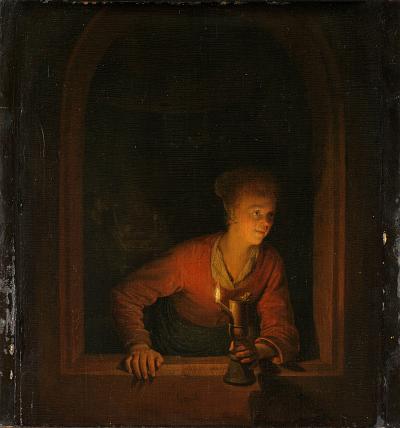
Gerrit Dou, who later called himself Gerard Dou, produced more than 200 paintings, which can be seen all over the world. He was Rembrandt's first pupil and in turn taught Quirijn van Brekelenkam the tricks of the trade. Dou was loved for his light/dark effects, candlelight and oil lamps.
The girl in the painting is holding an oil lamp, a so-called snotneus.
oil on panel, 19 x 17 cm
Dusart's Young man by candlelight reminds one of Rembrandt. Not so strange, because they were frequent visitors. Painting was a sideline for Christiaen Dusart; he had a dyeing shop with which he earned a lot of money. By partially covering the candle, the light falls beautifully on the young man's face and shines through his fingers.
oil on canvas, 65 x 79 cm
Country folk sing with a beer mug in their hand by the fire. They will not have been psalms. The interior shows prosperity: in the 17th century, the high mantelpiece was more likely to be found in city palaces than in farms. Many villagers could not afford the many metal objects either. Duyfhuysen therefore did not make his peasant scenes as a representation of reality, but as a mirror for the urban middle class. He depicted country folk as simple and harmonious people.
oil on panel, 46 x 62 cm
The desk is the central place in the classroom. The students sit together in a disorderly manner. We see a lamp above the desk, a mother with a lantern, students by candlelight, boys by a coal stove. The artistic challenge for Haanen lies in the representation of light and dark, the glow of the candlelight.
Haanen painted this scene in 1835, when for years only classroom education had been provided in which pupils followed the same lesson together. However, he must have been inspired by painters such as Dou and Versteegh, who recorded school scenes in the 17th and 18th centuries. Haanen depicts the situation before 1806, the year in which 'head-to-head education' was prohibited. Children of all ages and both sexes appeared individually (per head) in front of the desk to recite the lesson and receive new instructions. Then they went back to their own place in the classroom. Everyone is busy with their own lesson from their own book. Coming and going was not a problem in head-to-head education. Mother and child appear in the classroom, while other children are already busy.
The per capita education fitted perfectly in a society in which the school was a marginal institution, without compulsory education. If work had to be done at home, children did not go to school. Nor if the roads were impassable. School attendance was irregular, and therefore only made sense if you had your own program. If your parents thought it was enough, you left school. Without a diploma, there were no final tests. Per capita education therefore has nothing to do with the special attention today for the individual child and his personal disposition.
Evening education was an alternative to daytime education in the winter months before 1806, which was often neglected. Evening education was usually given from five to seven o'clock in the winter evening. We see that here too. It is almost five o'clock, it is getting dark outside and the stove is burning.
We see two educational activities: reading and writing. Parents valued a minimum reading proficiency for their children. The Republic had a high literacy rate. We see school bags on the wall, a stick and rod behind the desk, and writing is still done with a quill. The schoolmaster sits in full light. This is also meant symbolically: education is the source of enlightenment. In the left corner, an assistant teacher seems to be busy with a group of beginning spellers. The pupils are all children, but of different ages.
A beautiful painting. It breathes a tranquil atmosphere, while head education was notorious for its enormous noise. The noise is not painted along.
Jan Lenders, educational sociologist, Nijmegen
oil on panel, 64 x 50 cm
loan from the municipality of Amsterdam (legacy A. van der Hoop)
An old man is lighting a pipe. On the back wall, a pot hangs above a smoldering fire in the fireplace. The man is looking at the cat eating from a bowl. A similar work by Israëls hangs in The Philadelphia Museum, but the cat has been replaced by a dog. The work is called Silent Dialogue, to emphasize the man's old age and loneliness.
oil on canvas, 60 x 72 cm
legacy of Mr. A. van Wezel, Amsterdam
The girl keeps her feet warm on the stove. Jozef Israëls paints ordinary people in humble interiors.
Modest, inconspicuous. Don't imagine anything.
oil on canvas, 76 x 61 cm
donation from Mr. and Mrs. Drucker-Fraser, Montreux
The Frisian Johannes Jelgerhuis was friends with pharmacist Anthony d'Ailly and often visited his workshop. He may have bought the pigments he used for his paintings there. The pharmacist had a small factory, called the Stoockhuys, where he did his chemistry and turned his pills.
Because the company was a fire hazard, it was located on the edge of the city near the water of the Singel. In the painting we see a chimney, distillation installation, stove, pipe construction with medicinal liquids and barrels with ingredients.
oil on canvas, 43 x 52 cm
donation from AJ Rijk, Amsterdam
A ship sailing from Haarlem to Delft had a load of gunpowder on board and exploded in the middle of Leiden. 151 people died. The cause is unknown. Rumor has it that it was the fault of the cook on board who carelessly put the potatoes on the fire.
King Louis Napoleon immediately invested 30,000 guilders from his private assets in a disaster fund.
The disaster was reminiscent of the Delft thunderclap of 1654. At that time, the Delft Kruithuis exploded, killing hundreds of people, including the painter Carel Fabritius. In 1787, the
the gunpowder that was stored in the Church of Our Lady in Amersfoort. The nave of the church collapsed completely. More recent is the fireworks disaster in Enschede (2000), 23 dead.
oil on canvas, 86 x 114 cm
A model of contentment and domestic happiness; a spinning wheel, a sleeping cat, a pipe smoker. The farmer lights his pipe with a fire dome. A fire dome often had the shape of a square bowl with legs and an ear. With this one could safely move glowing coal. In the winter the farmer's wife put the fire dome in the foot stove to keep her feet warm.
oil on panel, 50 x 40 cm
Your own hearth is worth gold, a Dutch proverb that means that your family and your home are essential to your happiness. Around 1800, the Brabander Adriaan de Lelie continues the genre pieces from the 17th century. The old woman bakes pancakes and the old man lights his pipe with a fire test. Daughter and grandson come to smell and look. The tradition is passed on. And what is that bird doing in the cage?
oil on panel, 53 x 42 cm
legacy of Mr. JBAM Westerwoudt, Haarlem
With his drawing style, Liernur was appreciated by King William III. In 1871 he received the Royal Award for Free Painting. This award is still presented annually. In his Scheveningen cottage all the ingredients for coziness are present: a kettle above a burning fire, a teapot, a stove, a cat and a woman who is cleaning potatoes.
oil on panel, 13 x 17 cm
legacy of jhr. PA van den Velden, The Hague
Sometimes they are still on old pianos: the candlesticks to the left and right of the lid. Candles were needed to be able to read the score in the twilight.
oil on canvas, 36 x 22 cm
legacy of Mrs. AE Reich-Hohwü
The nuclear family seems to be the cornerstone of Dutch society forever: father, mother and the children (preferably two).
oil on canvas, 36 x 22 cm
legacy of Mr. A. van Wezel, Amsterdam
By the light of a single candle, the woman's mother has also fallen asleep. Behind her, a washed diaper hangs to dry over a stove, in which the coals no longer glow.
oil on canvas, 43 x 61 cm
donation from Mr. and Mrs. Drucker-Fraser, Montreux
In his dark forge, a blacksmith hammers a glowing iron rod on the anvil. His servant stands ready to anneal the metal in the fire. This was necessary repeatedly, to make the iron soft and workable again.
The proverb 'one must strike while the iron is hot' refers to this. Until well into the 19th century, every town and village had at least one (farrier) blacksmith for forging or repairing weapons, tools and parts of wagons and carts.
oil on canvas, 102 x 85 cm
Like Gerard Dou, Meulemans places the scene within the frames of a window. As a viewer, you feel like a voyeur. You can just see the moonlight shining through the upper window and the flame emerging from under the curtain. This makes the performance just a little more mysterious.
oil on panel, 50 x 40 cm
donation from J. Kesler PMz, Amsterdam
oil on panel, 25 x 20 cm
loan from the municipality of Amsterdam (legacy A. van der Hoop)
This painting is a composite copy of two works by Aert van der Neer. The left part of the representation is taken from a work that is in Avignon. We see a row of houses lit by the moonlight and a number of men warming themselves by a crackling fire.
The right half of the painting, with the river and the city in the background, may have been painted after another but unknown work by Van der Neer.
oil on panel, 43 x 58 cm
donation from Mr. and Mrs. Kessler-Hülsmann, Kapelle op den Bosch
Amsterdam painter Oberman poses with a palette, brushes and a painter's stick. He self-confidently signs his painting on the cover of his drawing folder. The coal stove is prominently displayed. Oberman is clearly proud of this innovation, which can be used to comfortably heat his studio. The ash pan has been slid out of the stove to allow extra oxygen to reach the fire. The crooked poker with which the fire can be poked lies in front of the stove.
oil on canvas, 36 x 44 cm
donation from the Belport Family Foundation
Willem van Odekercken was born in Nijmegen and painted in Delft and The Hague. He devoted himself to small paintings with scenes from everyday life. Open fire, as seen here in the kitchen of a city house, could be found on every ground floor at the time. All kinds of expressions still remind us of cooking in pots over an open fire: wat de pot gereift, een potje kunnen koken, Hollandse pot, de pot bekommen, moeders pot.
Scrub the pots and kettles clean was hard work. But the maid seems to get satisfaction out of it. Shiny clean copperware was something to be proud of.
oil on canvas, 73 x 59 cm
donation from Mr. A. Willet, Amsterdam
Godfried Schalcken was, like his teacher Gerard Dou, a specialist in painting scenes by candlelight. Reflection, reflection, the scattering of light in darkness and the path it takes over different materials, no effect was too difficult for him.
oil on panel, 43 x 31 cm
Jacobus Schoemaker Doyer was a minister's son, became a painter, was friends with Thorbecke and died in Zutphen. Today he is known only for his paintings of the hero Jan van Speijk.
Jan van Speijk was commander of a gunboat; a sailing ship with one cannon. During the Belgian Revolt he had taken part in the bombardment of Antwerp (27 October 1830).
With his ship he carried out checks on the Scheldt. When the ship and its crew were threatened by Belgian rebels, he blew up the ship by putting his cigar in a barrel of gunpowder. According to tradition, he said: "... become an infamous Brabander? Then I'd rather go up in the air."
Be that as it may, 28 of the 31 crew members died, including Van Speijk himself. Jan van Speijk became a national hero with this act and was given a grave in the Nieuwe Kerk in Amsterdam. He was prepared to commit a suicide attack for king, people and fatherland in order to do as much harm to the enemy as possible.
Van Speijk's name became canonized after his deed. For a long time, he was seen as a great naval hero in the Northern Netherlands. His deed was considered an example of a sense of duty, heroism and honor. There was no attention for the survivors. Only a few Belgian newspapers provided information on the basis of which the correctness of Van Speijk's actions could soon be rightly doubted. It was not until 1839 that the Netherlands recognized the independence of Belgium.
oil on canvas, 25 x 20 cm
loan from the municipality of Amsterdam (legacy A. van der Hoop)
A young woman reads from the Bible. The old woman in fur trimmed black sits by the fireplace, where a wood fire burns. Scholten liked to paint scenes from the 17th century. Besides being a painter, he was also a curator at the Teylers Museum. In their admiration for the Golden Age, 19th-century Dutch painters liked to refer to virtues that they considered typically Dutch; piety, cleanliness and domesticity
oil on panel, 55 x 67 cm
After Jan van Speijk's desperate act, there was an immediate great demand for images of the historical event. Most artists depicted Van Speijk just before he lit the gunpowder. Schouman chose the enormous explosion afterwards, with Antwerp in the background. The ship is such a sea of fire that even the clouds take on an orange glow.
oil on panel, 53 x 76 cm
loan from the municipality of Amsterdam (legacy A. van der Hoop)
This messy inn interior was given the title Twofold game, referring to both the backgammon players and the old man who grabs the landlady for a completely different game. Jan Steen viewed his fellow man with humor and irony.
Only the good listener would recognize his warning against a dissolute life, wrapped in the symbolism of everyday objects. For example, the fire test with coals refers to fiery desire, the backgammon game to foolish waste of money, the empty mussel shells and eggshells to lust and the landlady's red stockings to her special 'extra earnings' at the inn.
oil on canvas, 63 x 70 cm
donation from Mr. and Mrs. Kessler-Hülsmann, Kapelle op den Bosch
The Rotterdammer Tavenraat liked to paint dramatic weather conditions. The lightning that flashes through the sky falls precisely on the fleeing deer. The evening red glows fiery on the horizon. The pair of birds at the top of the tree, however, seems unaffected by the violent thunderstorm. (Dutch art 1800-1900, p.129)
oil on panel, 31 x 40 cm
For centuries, the rhythm was strongly determined by daylight. The hearth fire gave little light. Candles and lamps were there, but they smoked, spread an unpleasant smell and were expensive. The oil lamp depicted was known as a 'snotneusje'.
Versteegh liked to paint light effects and contrasts and therefore placed the lamp in the middle of the room. In practice, artificial light was usually placed by the window, as additional light. After all, that's where people sat. It was only with the arrival of electricity that light moved to the centre of the room.
oil on panel, 49 x 43 cm
loan from the municipality of Amsterdam (legacy A. van der Hoop)
Evening school in the 18th century had numerous variations for young and old: reading, writing, arithmetic, French. Evening school was a private initiative, literally. You hung a sign on your door with your expertise (language master, writing master, arithmetic master) and received money for the services provided. The zzp formula.
In addition to the 'side schools' (as they were called), there were parish and city schools for daytime education, owned by the local government and supervised by the Calvinist church.
Private education usually required permission from the local government, which wanted to limit competition with its own schools.
In the painting, the students are standing in line in front of the desk to recite their own lesson. The teacher is again the center of attention, just like in Haanen's painting. It looks like a school for older children. Judging by their clothing, the audience is from the upper middle class. It could very well be that this is a French lesson. French was the language of the elite and trade, very popular in higher circles. The teacher is wearing a special cap, he is dressed joyfully in comparison with the usually dull appearance of the classic schoolmaster. And that hat of the young man on the left is also striking. On the left in the foreground is the cleaning girl, shrouded in darkness. She is cleaning up the mess of the elite, but does not seem to be impressed by their decadent appearance. Is the painter here placing the enlightened nation against the stupid people? Or does she represent the intelligence of the productive class against the good schoolmanship of the unproductive?
The work was created during the heyday of the Dutch Enlightenment, when heated debates took place about the necessity and dangers of popular enlightenment and education.
The Dordrecht resident Michiel Versteegh liked to paint candlelight; he played with light and dark, that was his main motif. With his candle work he gained so much fame around 1800 that even Napoleon wanted a painting by his hand.
Jan Lenders, educational sociologist, Nijmegen
oil on panel, 60 x 52 cm
legacy jhr. PA van den Velden, The Hague
Philips Wouwerman's trademark is the horse, especially the grey. He was a talented horse painter, very popular with art collectors in the Golden Age. In this painting, the farrier is covering a horse in a romantic landscape. There was always an open fire in the forge and when the metal was worked on the anvil, sparks flew around. The blacksmith was an important craftsman, and no village or town could do without one.
oil on canvas, 62 x 55 cm