








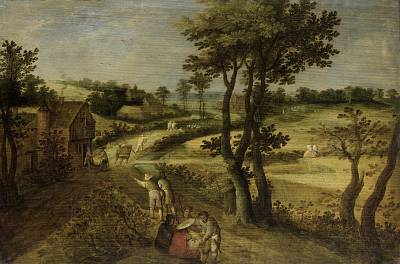




An elegant company walks along the driveway in front of a country house, which is surrounded by a wide moat. On the left is a farmstead and meadows where cattle are being milked. A man and a woman rest in the grass.
Wealthy Amsterdammers founded estates and country houses in the 17th and 18th centuries. They longed for a country house. The gardens at the houses were beautiful, usually inspired by the formal French style of garden architecture.
Living richly outside the city has been named as one of the fifty windows from the canon of Dutch history. Much of the nature that still exists today is thanks to these private initiatives.

oil on panel, 27 x 34 cm
In the fields behind the fishermen and farmers, hay is being harvested and cattle are grazing. On the left, people are playing dice at a hollow post mill. It is assumed that this painting was painted just outside Amsterdam; the couple in the middle are wearing clothing from the Waterland region. The jug that the woman is holding is German stoneware from the Westerwald. Imported, baked clay!
Arent Arentsz is a famous Amsterdam painter, nicknamed Cabel. He lived in the 17th century and liked to paint landscapes with fishermen, hunters and farmers. Arent Arentsz is represented in the collection of the Rijks with five paintings.
oil on panel, 26 x 51 cm
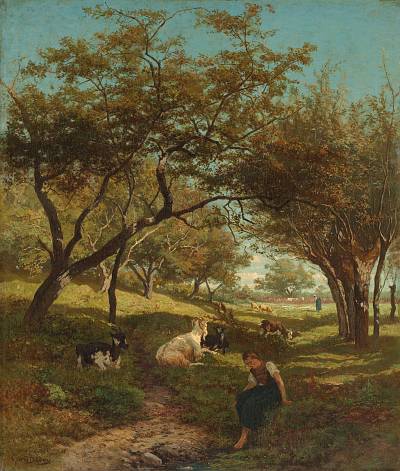
As the son of Johannes Warnardus, the twenty-year-old Gerard Bilders, an aspiring painter, travelled through Switzerland on foot and by carriage.
There he suffered from artistic homesickness. “Switzerland is undoubtedly beautiful and grand, but when I think of the Gelderland landscapes and animals and the dark oak green, I feel in my heart that I am Dutch and want to paint Holland.”
Gerard Bilders dies young, 27 years old. A year before his death he paints 'Goatkeeper'. In 1864 he writes about it in a letter: "A painting that depicts an orchard, furnished with goats and a girl from Oosterbeek, has been causing me a great deal of trouble lately."
oil on canvas, 28 x 43 cm
legacy of Mr. JBAM Westerwoudt, Haarlem
Thanks to JW Bilders, Oosterbeek grew into an artists' village in the 19th century, the Gelderse Barbizon.
This Bilders was the pater familias for painters such as Anton Mauve and Paul Gabriël, friends of his son Gerard Bilders.
Every year he celebrated his birthday with a large group of artists. This was done according to a fixed ritual. Bilders, dressed as a druid, led a procession to the heath and the oaks to honor Wodan and Thor. Hence the name 'Wodan's oaks centuries-old oaks of which five are still standing. If there was a newcomer, Bilders personally baptized him in the stream.
oil on canvas, 103 x 153 cm
Son of Johannes Warnardus Bilders.
oil on canvas, 28 x 43 cm
legacy of Mr. JBAM Westerwoudt, Haarlem
Théophile de Bock preferred to paint in Drenthe. He and his contemporaries found that province to be 'picturesque'.
The Rijksmuseum has seven paintings by De Bock in storage, including this forest scene with crows. He not only painted landscapes and forest scenes, he also photographed them. He used his photos as a memory aid.
In 1881 De Bock collaborated
oil on canvas, 32 x 51 cm
legacy of Mr. JBAM Westerwoudt, Haarlem
Amsterdam was his habitat. In Paris, Breitner had become acquainted with Impressionism and from that moment on Breitner painted the Amsterdam street life. That is how he became famous. He liked to call himself 'le peintre du peuple'.
Yet Breitner also painted in nature, quick oil sketches in Drenthe and Holland. This farmstead is situated near a body of water, perhaps against a polder dike.
oil on panel, 26 x 40 cm
legacy of Mrs. MCJ Breitner-Jordan, Zeist
Jacob Cremer felt more like a writer than a painter: “Ink flows better than paint.” Cremer is best known for his protest against child labor. Yet he always continued to paint, especially Gelderland landscapes.
The Rijksmuseum keeps one copy by his hand in its depot.
The yellow sandy soil and the old oaks are typical of the Gelderland landscape west of Arnhem.
oil on canvas, 68 x 101 cm
purchase with a contribution from the JG Krul legacy
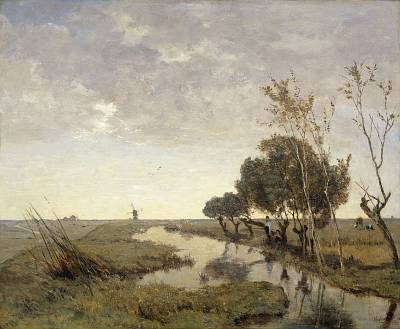
Gabriël called himself 'peintre paysagiste des Polders Hollandais'. He lived in Brussels for a long time, but the Belgian landscape could not charm him.
“No, I don't feel much for that, there is not that nice atmosphere of Holland. Although I can look a bit grumpy myself, I like the sun shining in the water. What struck me particularly when I came from abroad: our country is colorful and juicy fat.”
oil on panel, 37 x 58 cm
legacy of Mr. JBAM Westerwoudt, Haarlem
Gabriël liked to paint in the area around Kortenhoef and Abcoude. Kortenhoef was one of the lowest peat areas in the west where peat extraction would continue well into the 20th century. A wetering is a watercourse that serves to drain the area.
oil on panel, 41 x 50 cm
legacy of Mr. JBAM Westerwoudt, Haarlem
The sand skipper transports sand from the excavated dunes to the new neighborhoods of The Hague. The canal depicted was close to Israëls' home on the Koninginnegracht in The Hague. He could see the sand ships from his living room.
Jozef Israëls considered human life as a difficult journey. He preferred to paint simple people in their own environment. His 'Jewish Wedding' from 1903 is just as moving as Rembrandt's 'Jewish Bride'.
oil on canvas, 62 x 90 cm
legacy of Mr. CD Reich
You can see that Kobell has looked closely at the work of the 17th century Paulus Potter. He learned the trade from his father, who was a marine painter. All attention is focused on the two cattle that, not coincidentally, are different in color. They leave the prickly blue thistle untouched. Oxen were often used as draught animals in the past. The castrated bulls retained their strength, but not their temperament, which made them very suitable for agriculture to pull wagons and plows.
When we look at the background, a row of dunes seems to be visible.
oil on canvas, 67 x 84 cm
Jac van Looij was a writer and painter. He lived in Soest and later in Haarlem. He is considered one of the minor masters. The Rijksmuseum owns four of his paintings, including the magnificent 'Zomerweelde'.
The close-up 'Clover Flowers' immerses the viewer completely in nature. With your eyes and nose in the blooming clover. Taco Dibbits says about his favorite work: "It smells like you're lying in the meadow."
oil on canvas, 39 x 46 cm
legacy of Mr. A. van Wezel, Amsterdam
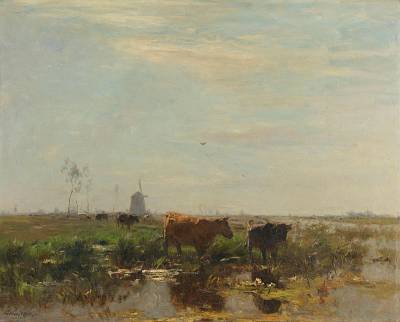
The vastness of the Dutch landscape is only interrupted by cows and the contours of a polder mill. Although the vegetation is not detailed, it is clear that the diversity of grass species in the 19th century was much greater than in most meadows today.
The use of pesticides and fertilizers has played an important role in this development.
oil on canvas, 87 x 108 cm
donation from Mr. and Mrs. Drucker-Fraser, Montreux
Today, Willem Maris' paintings evoke a longing for the idyllic landscape of the past.
Willem Maris is the lyrical interpreter of the Dutch landscape. Although he himself said: "I don't paint cows but light", cows at the ditch are still seen as his ultimate specialty.
oil on canvas, 49 x 100 cm
donation from MC Baroness van Lynden-van Pallandt, The Hague
His 'Polder after a thunderstorm' is the wettest, freshest and most sparkling work that Jacob Maris ever painted. The precise brushstrokes suggest a rowing boat in the water and a mill on the horizon.
The sky is reflected in the water, creating a familiar image that still exists in the Vecht lakes and the area near the South Holland North and Nieuwkoop.
Vincent van Gogh wrote: “A painting by Mauve or Maris or Israëls speaks louder and clearer than nature itself.”
oil on canvas, 54 x 62 cm
legacy of Mr. CD Reich
What Willem Maris had with cows, Anton Mauve had with sheep.
Characteristic of Mauve is the suggestion of intimacy and the atmospheric silver-grey tone. Anton Mauve, a minister's son, was called the 'master of the silver light'. The artist painted this work in Laren, where he went to live three years before his death.
He was only 49 years old.
oil on canvas, 54 x 82 cm
legacy of Mrs. AE Reich-Hohwü
In 1905, the journalist Geronimo de Vries wrote upon seeing this painting: “Our Gooi painter has become so much the court poet of the sheepfold that we almost forget how much he is also the poet of the horse and cart.”
oil on canvas, 37 x 51 cm
donation from Mr. and Mrs. Drucker-Fraser, Montreux
oil on canvas, 36 x 49 cm
donation from Mr. and Mrs. Drucker-Fraser, Montreux
The water plants in the foreground are rendered with wafer-thin strokes. The cloudy sky is made up of a tangle of broad strokes. The last sunlight disappears behind the clouds, just reflected in the water.
This painting dates from the first year that Mauve lived in Laren. With his paintings of heathlands, flocks of sheep, sandy soils and birch groves, Mauve made the landscape around Laren famous, silvered it. That is why people speak appreciatively of 'The land of Mauve always in a silvery atmosphere. His impressive painting 'The swamp' also comes from this area, but is much more threatening and darker.
oil on canvas, 60 x 90 cm
donation from Mr. and Mrs. Drucker-Fraser, Montreux
Anton Mauve is the painter of the Low Countries par excellence. He painted in the area around The Hague, in the Gooi Laren and the Gelderse Oosterbeek. Like his contemporaries, he captured the landscape that was going to disappear. 'Horses at the Fence' is set in the rural area around The Hague. That landscape was also going to disappear.
Mauve captured nature in his sketchbook and later worked out his sketches in the studio.
oil on canvas, 43 x 25 cm
legacy of Mr. JBAM Westerwoudt, Haarlem
Isaac is the younger brother of Adriaen van Ostade. He left behind 100 paintings, three of which are in the collection of the Rijksmuseum.
His paintings give a vivid picture of everyday life in the 17th century. Isaac never made any major journeys in his short life (28 years).
He left his hometown of Haarlem only for trips in the area, an area with dunes and lowland peat meadows. It is likely that this work was painted there.
oil on panel, 56 x 47 cm
loan from the municipality of Amsterdam (legacy A. van der Hoop)
Geo Poggenbeek gave the Dutch countryside a young, bright green colour. An extremely modest Amsterdammer, who liked to paint willows, calves, cows and towns.
oil on cardboard, 26 x 22 cm
legacy of Mr. CD Reich
Willem Roelofs painted in the open air, en plein air. He pinned the canvas with drawing pins in his painting box.
oil on canvas, 30 x 43 cm
legacy of Mr. HFW Jeltes, Velp
Willem Roelofs wanted, according to himself, to paint 'the breath of nature'.
He lived in Brussels for a long time, but always came to Holland, Gelderland and Drenthe in August and September. Belgium did not appeal to him.
He was devoted to our landscape. A reviewer wrote about his work in 1889: “It seems as if the painter had dipped his brush in the sunlight itself.”
oil on canvas, 27 x 44 cm
legacy of Mrs. VR van Poelgeest-Spatkowa, Amsterdam
Little is known about his life, but much more is known about his work.
Jacob van Ruisdael lived in Haarlem and Amsterdam. His most famous work is 'The Mill at Wijk bij Duurstede which can be seen in the Gallery of Honour of the Rijksmuseum.
Jacob van Ruisdael had something of a drama queen in his work. He painted his landscapes just a little more impressive than in reality and the cloudy skies even stormier. In 'The ford' children are playing and a coachman is letting his horses drink in the water.
oil on canvas, 67 x 85 cm
purchased with the support of the Rembrandt Association
After harvesting, the very poorest were allowed to search a field for potatoes left behind. It is an almost biblical scene: a woman kneels by a basket, another scoops and the last collects the potatoes in her apron.
Sadée was born in The Hague in 1837. He learned to draw at a young age and travelled extensively through Europe. However, his native region continued to attract him.
“But love for one's country is innate in everyone and so, after many detours, I returned to our own coasts, where a stay in Zandvoort or Scheveningen would have given me much more beautiful things to see.”
In Scheveningen Sadée painted daily life on the beach and in the dunes. He was friends with Julius J. van de Sande Bakhuyzen.
oil on canvas, 61 x 121 cm
Julius, born in The Hague, received his first painting lessons from his father Hendrikus van de Sande Bakhuyzen.
He spent most summers in Drenthe, sometimes together with his friend Willem Roelofs. The province of Drenthe was loved for its unspoiled nature, sand drifts and flocks of sheep.
oil on canvas, 55 x 96 cm
Hendrikus was a native of The Hague with a studio at the Nieuwe Haven. He devoted himself to painting animals and landscapes, clearly inspired by Paulus Potter.
He worked in the open air, taught Willem Roelofs and is considered one of the forerunners of the Hague School. He painted this self-portrait on commission from an American collector, who already owned a Gelderland landscape with cows and a horse by him.
oil on panel, 72 x 97 cm
Travellers and a shepherd with sheep are walking along the road. In the foreground are two gypsy women who are reading the hands of two farmers. It is clear that the landscape was already cultivated in the first half of the 17th century, as evidenced by the cornfields. In various places, farm workers are busy with scythes or rakes. The couple on the right has other priorities. The two flocks of sheep illustrate the use of the other lands.
The Flemish Savery family fled, like many others around 1584, the Southern Netherlands. The family moved to Haarlem and later to Amsterdam. This migration was very beneficial to the prosperity and cultural climate in 17th century Holland.
oil on panel, 29 x 42 cm
purchased with the support of the Rembrandt Association
Here peat, an important fuel, is extracted from under the water table; a technique that is often used in the western and northern Netherlands. The man in the boat dredges peat from the water, which is then spread over the land. The woman in the background stamps the peat drying in the sun into a hard mass. It is then cut into manageable blocks with a spade. The peat lies in piles on the land to dry.
Schweickhardt was born in Germany, lived for many years in The Hague and died in London.
oil on panel, 28 x 38 cm
The Rotterdammer Tavenraat received a lot of criticism for his work in his time, but he didn't care. He was rich and didn't have to live off the proceeds of his work. He painted with loose broad strokes, spontaneous and direct.
He painted this sand excavation in the area around Ginneken.
oil on paper on hardboard, 28 x 37 cm
donation from the 't Schou' Foundation,
Van Troostwijk died at the age of 28, leaving behind eight paintings, four of which are in the possession of the Rijksmuseum. Van Troostwijk is perhaps the least known of all the painters in the Low Countries exhibition, but nevertheless one of the greatest talents.
In daily life he was a janitor at the city hall of Amsterdam. He is a master in the atmospheric rendering of light. He did not compose an ideal nature.
He gave loving attention to everyday motifs, such as here a bleaching field at a Gelderland farm. The bright light and the ripe green make this a truly Dutch landscape.
oil on canvas, 45 x 40 cm
Vincent van Gogh appreciatively called Johan Hendrik Weissenbruch 'le joyeux Weiss'. He painted a lot in the Groene Hart: polders, mills, skies.
He was friends with that other polder painter Willem Roelofs. Weissenbruch once said: “When I saw beautiful corners of beautiful beach, beautiful waterways, beautiful skies, or gazed at the sea from the dune, I became absorbed in the beautiful, in nature.”
Unlike Roelofs, Weissenbruch was a homebody. He hardly ever left South Holland. In the wide area around The Hague and Gouda he drew in the open air with chalk and worked out his drawings in the studio.
oil on panel, 21 x 34 cm
donation from Mr. and Mrs. Drucker-Fraser, Montreux
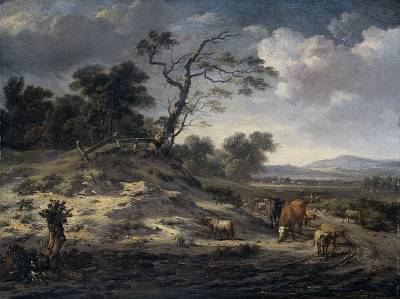
This seventeenth century painting clearly shows the tradition of nineteenth century artists. With the dominant purple-blue tones, Wijnants also created a beautiful atmosphere.
Jan Wijnants worked in Haarlem, Rotterdam and Amsterdam. He gave his dune landscapes an Italian touch, although he himself had never been to Italy.
oil on panel, 27 x 35 cm
The hunter on the road gestures to his two companions on the dune, against the edge of the forest. One holds two hares in his hand, the other is just climbing towards the dune ridge. Dogs sniff and run up and down the dune.
In the distance, where the road disappears from view, a herd trots ahead of a shepherd. A bull mounts a cow. Movement in a still land.
oil on canvas, 37 x 34 cm
Willem Witsen is best known for his Amsterdam cityscapes. But he also went outside sometimes, as this painted sketch proves. The Tachtigers were among his friends: Willem Kloos and Herman Gorter. After his marriage he moved from Amsterdam to Ede, 1894, where he probably painted 'Vegetable Garden'.
oil on panel, 27 x 35 cm
legacy of Mr. A. van Wezel, Amsterdam